My study abroad experience personally inspired growth, but didn’t affect my post-graduation or academic plans because I’m a senior and I have a job lined up for after when I graduate.
As a result, when I met with my success coach and discussed my future plans, and how they’ve been affected by going abroad, I’ve realized that it’s more impactful to consider the skills that I’ve gained, and how I could communicate/utilize them in a work environment.
The main skill that I worked to cultivate while abroad was flexibility. From the very first day, I intentionally leaned into being flexible. On that first day, in Copenhagen, I locked myself in the bathroom and slid to the ground, on the verge of tears because I was overwhelmed with the fact that I was so far from my family, and I was already experiencing culture shock. But I recognized the moment as a deciding one that would define my attitude for the rest of my four months in Copenhagen, and I chose to lean in.
Flexibility is not my main mode of operation, but with each passing day in Copenhagen, I sought to be a little more flexible and step a little further out of my comfort zone by testing the new language, seeking new cross cultural experiences, or simply saying yes to whatever new adventure my host family had planned for that day.
Flexibility is also crucial for me in the work place. Through Mendez’s reading, I was reminded that I am a schedule-oriented person. I often feel blindsided by frequent change and disruption to my plans. I also spend a good amount of time creating detailed strategies, and am forced to revise them when circumstances change. I also may be surprised if I am asked to help in areas outside my normal duties and I can feel threatened by unpredictable environments.
According to his reading, I can grow by understanding that change is a fundamental part of my work environment. I can also understanding and appreciate the importance of flexibility to my advancement. Instead of detailed strategies, I can develop general strategies such as scenario planning to avoid investing too heavily in a single direction, such as prototyping ideas instead of instantly devoting myself to a life plan. Alternatively, I can also create flexible plans that don’t need to be reworked each time conditions change.
A second skill that I worked to cultivate was cross-cultural awareness, or more generally, a capacity to analyze that which is different from what I am familiar with. One of my running observations, both in Denmark and now in the United States, stemmed from my analysis of the differences between Danes and Americans that I discovered while abroad. I think that there’s a stark contrast between our public personas. When I walked around the streets or rode the metro in Copenhagen, I would try to meet people’s eyes, smile, and generally exude warmth. In return, all I received was coldness: blank stares and confused looks. I realized that Americans have warmer public personas (or at least Los Angelenos do), and this was a cultural expectation I carried with me from the States.
I think that this would be an invaluable skill to have in any work environment, particularly when I want to pick up on the indirect communication happening in a meeting or other interaction between colleagues. I’m confident that I will put this to use when I begin work in the summer to read my surroundings, and this case, the micro-culture of my work environment.
A third skill that I gained was my exposure to a different understanding of sustainability through the Danish perspective of the way we approach architecture, and more widely, life. One of the most inspiring moments came through a visit to the architecture firm EFFEKT Studios in Copenhagen. They presented a number of projects that they were working on, and one caught my eye.
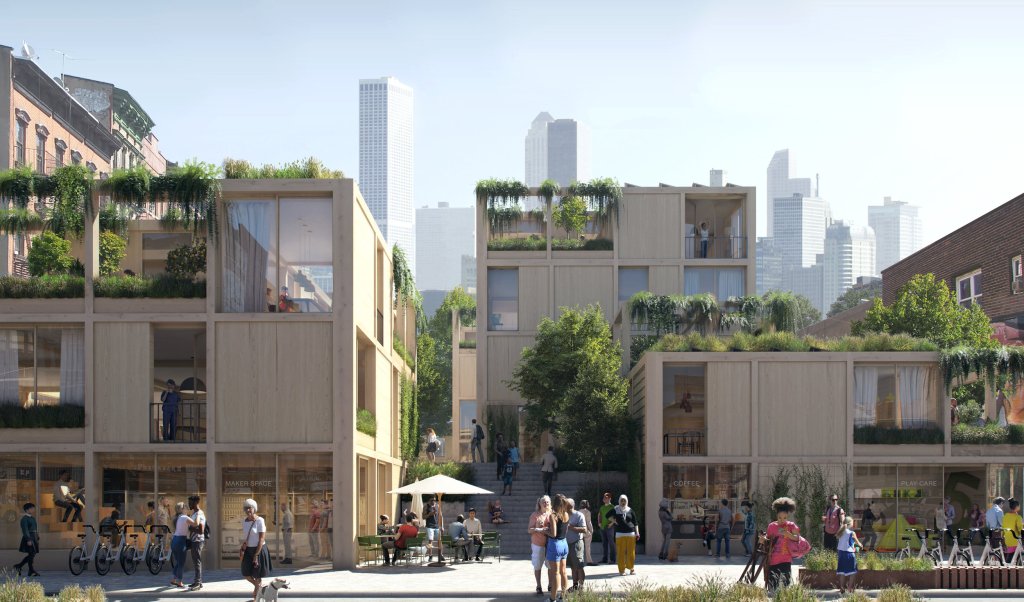
They spoke about the Urban Village Project, a new visionary model for developing sustainable, affordable and livable homes for the many people living in cities around the world. Here’s a little bit from their website about the project:
“Cities all around the world are facing major challenges when it comes to rapid urbanization, ageing populations, loneliness, climate change and lack of affordable housing. It is clear that unless we rethink our built environment, our cities will become increasingly unsustainable, unaffordable and socially unequal.
Urban Village Project envisions:
- A modular wooden building system designed for disassembly, that can be prefabricated, flat-packed and quickly assembled on site. This ensures a more sustainable and CO2-reducing construction method and a circular approach to the management and life cycle of our buildings.
- A new financial model that drastically lowers the entry point to the housing market, making high quality housing affordable for users of all income classes, while re-establishing the connection between the developer and the consumer.
- Cross-generational shared living communities in the hearts of our cities with flexible, high quality homes connected to a variety of shared services and facilities; and a digital interface to support everyday needs.”
I was particularly taken by their proposal, which reflected a number of Danish values when it comes to sustainability. One of the primary ideas is that sustainability should not be a primary goal, but should instead be paired with another goal or issue. In the States, sustainability is incredibly one dimensional in the architecture field.
In the Urban Village Project, the architects decided to tackle both sustainability and our growing housing crisis in almost all developed countries. They were even more clever by pairing these issues with a current solution. They sought to create a modular system by partnering with IKEA and the way that they mass produce interchangeable and customization pieces to create a product. In this case, the product would actually be a home, with multiple parts coming together to create a system to face the looming housing issue.
It was ingenious, and encouraged me to think about and consider solutions/options that are outside of the box. For example, California is seeking to pass a new building code that requires new buildings to be energy neutral in 2022. This is a great step, but I wonder how it could be paired with other issues. I will need to explore this further!
 Follow Me to DenMARK