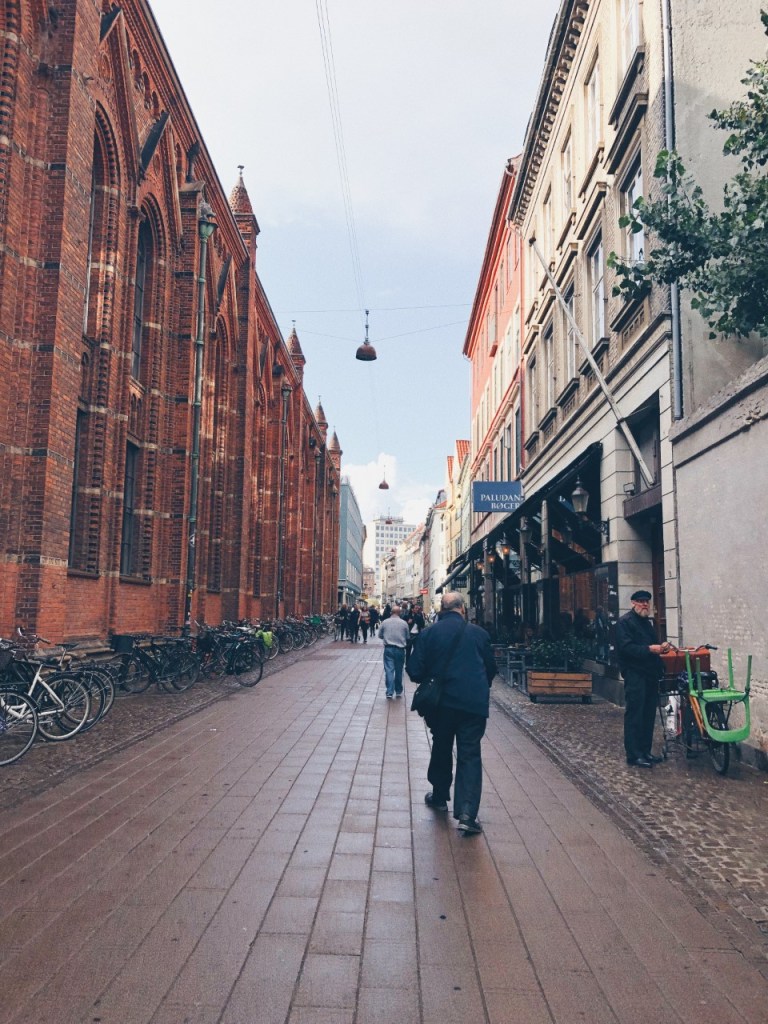
As I reflected on where I wanted to observe tourism in New Orleans, I returned to my time in Copenhagen, and the places that I would enjoy sitting for hours. I’d be present in the urban environment, people-watching in a way that made me reconsider myself and American culture. My favorite place in Copenhagen was Cafe Fiol, where I would spend hours sitting on the corner of Fiolstraede and Rosengarden.
There were a number of reasons that I chose this cafe. Firstly, I enjoyed the ambience of the cafe. Second, there was outdoor seating on the corner of this street intersection. And third, I intentionally chose a spot that was outside of the more traditionally touristy part of Copenhagen. Stroget and the areas around that were clogged with tourists, whereas the area around Cafe Fiol was visited by tourists and locals alike.
As a result, I followed a similar vein of thought with my observation of tourism in New Orleans. Instead of going deep into the French Quarter, which would have almost entirely consisted of tourists, I chose to find someplace to sit along Magazine Street. Magazine is definitely still touristy, but not in the same way as the French Quarter. I hoped to find a blend of locals and tourists, and I think I was able to do that. I also wanted to find someplace with outdoor seating that was near an intersection. I ended up choosing the Dat Dog near the corner of Louisiana and Magazine. Although I knew it wasn’t a cafe, it was overall a pretty similar experience to people watching in Copenhagen.
I spent Wednesday afternoon and evening from 4 to 8 pm at the site. I was sitting with my friend, and we got to have some fun conversations about cross cultural differences while observing the people around us. One of the fun games we played was guessing whether people were locals or tourists based on the way they carried themselves. Locals were people who were just walking down Magazine on the way through their daily routines, whereas tourists were people who were looking around excitedly and taking photos and/or seemed lost/out-of-place. By the end of the day, we averaged that it was probably about 40/60. 40% locals, 60% tourists. However, that number shifted when we thought about who actually entered the Dat Dog establishment. It was probably closer to 60/40. 60% locals, 40% tourists. However, that all shifted in the last hour because Wednesdays are trivia night, meaning that locals dominated the business then.
On the corner/up-and-down Magazine, people meandered. Many people were exploring the city for the first time, and I took a photo for a couple who had traveled to New Orleans for Krewe du Vieux, but wanted to get out of the craziness of the French Quarter for a night. I realized how slow moving people were on the street. People moved down the street in New Orleans slowly, either interacting with the people they were with or other people on the street. People (tourists most likely) stopped to take photos of the buildings and each other. This was extremely different from Cafe Fiol, where most people were rushing to work or the next thing, and moving very quickly down the street. Here people meandered.
Sitting there for four hours reminded me that New Orleans is a city of food and drink. Sitting there outside of the Dat Dog, I was constantly smelling and seeing people eating, both at the restaurant, but also walking down the street. However, one of the things that reminded me of Copenhagen was how comfortable people in New Orleans are about carrying around alcohol. Later at night, and especially during the weekends in Copenhagen, people walking around drinking beer was completely normal. However, there was a stark contrast between night and day in Copenhagen. During the day, people were professional and rushed. During the night, people slowed down and carried around alcohol and unwound a bit. In New Orleans, the relaxed environment, particularly around alcohol was pretty consistent, besides the fact that the traffic picked up significantly after the sun went down.
Doing this activity allowed me to continue to process the realizations about the differences between Danes and Americans that I discovered while abroad. It reinforced my theory about the public versus private persona of the Danes. There’s a stark contrast between our public personas. When I walked around the streets or rode the metro in Copenhagen, I would try to meet people’s eyes, smile, and generally exude warmth. In return, all I received was coldness: blank stares and confused looks. I realized that Americans have warmer public personas (or at least Los Angelenos do), and this was a cultural expectation I carried with me from the States.
By comparison, Americans have a higher expectation of warmth in public, and this was on display on Magazine street. Sitting at our table on the sidewalk, we were constantly waving, smiling, greeting, and laughing with people who were moving down the street. It was a stark contrast to my time sitting outside Cafe Fiol, where the Danes would hardly meet my eye.
Also, this was a refreshing activity because it reminded me how much I enjoyed intentionally taking time to engage cultural activities that crossed cultural lines. To go from a semester of focused time engaging a new culture, and constantly assessing those around me, to basically turning my cultural awareness “off” when I returned to the States was a strong difference that I only realized had occurred through this activity. It’s definitely something that I want to continue to do, but probably more in doses rather than the 24/7 of my time in Copenhagen.
Listening in on conversations further illuminated the difference between Danes and Americans. Although Americans have a higher expectation of warmth in public, we also expect that friendships will slowly and steadily grow over time as we invest time and energy. The process from stranger to acquaintance to friend to trusted person doesn’t happen overnight. We peel back our layers as we each take steps towards each other. By contrast, the Danes are explosive and immediate relationally. They are cold in public, but as soon as you switch from stranger to acquaintance in their eyes, all bets are off. The transformation from public to private is night and day. I experienced this across the board with my host family, my host family’s friends, my professors and even my organizers for service learning. Multiple times while in Denmark, I distinctly remember thinking, “we only met an hour ago” because we were discussing anything from politics to personal trauma to familial drama.
The dynamic was different on Magazine Street. People’s conversations were quite dull. Although Americans are louder, I remember continuing to be confused by conversations I would overhear in Denmark at cafes and in restaurants where Danes would allow their private persona out. I couldn’t believe what people would talk about. On the other hand, the conversations I overheard on Magazine Street were pretty mundane, about what people did that day, etc. There was also so much complaining. It was too cold. They were very hungry. The food was taking too long. They weren’t drunk enough. The list goes on and on haha.
Insider language that did start to crop up as more locals came out of the woodwork for trivia night was around Mardi Gras season, and how to do it “well”. How to avoid the touristy areas. Where to get the best throws. I definitely became more aware of how strategically locals will approach Mardi Gras season as huge numbers of tourists flood into their city. It appeared to be a whole type of conversation that multiple groups of people were having as they prepared to engage Mardi Gras season.
I think some fun questions going forward are these:
- Is this ratio of tourist to local typically this close? When does it spike to locals? When does it spike to tourists?
- What do locals discuss when it isn’t Mardi Gras season?
- What other insider language did I miss due to the brevity of this activity?
- What other comparisons exist on Magazine Street between American culture and European culture?
 Follow Me to DenMARK