It’s been about 2 and a half months since I landed back in Los Angeles after my time abroad. Either intentionally or subconsciously, I filled my life and really haven’t given myself time to process my experiences abroad. Sure, I’ve told people how wonderful it is from a bird’s eye or a quick five minute conversation, but today I dive back in by mentally mapping the places that were important to me while abroad.
And my gosh, it’s weird to draw a map of Copenhagen. As I did this exercise, I came to the powerful realization that I haven’t given myself time to process the mundane. Up until this point, I’ve only focused on the overall experience, but as I traced my pen, I relived so many specific moments that came together to form a powerful experience abroad. Riding the metro to class. Riding my bike to class in 30 degree weather after I lost my travel pass and insisting on being a “viking”. Playing soccer with local Danes at the Vanløse football club. Grabbing coffee at Fiol, and watching people walk by. Working on homework in the ancient part of the Royal Library, aka the Black Diamond. Testing my Danish with the barista at Fiol, who I got to know after my frequent visits. It all came rushing back as I traced my pen, and I felt pretty nostalgic.
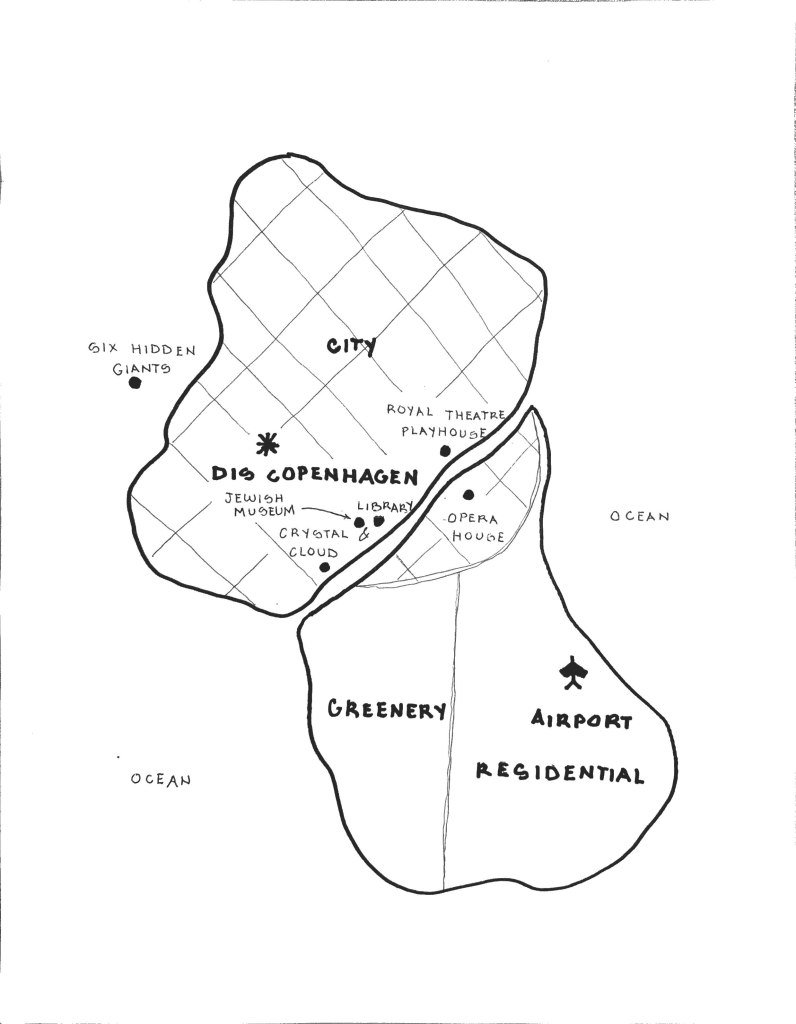
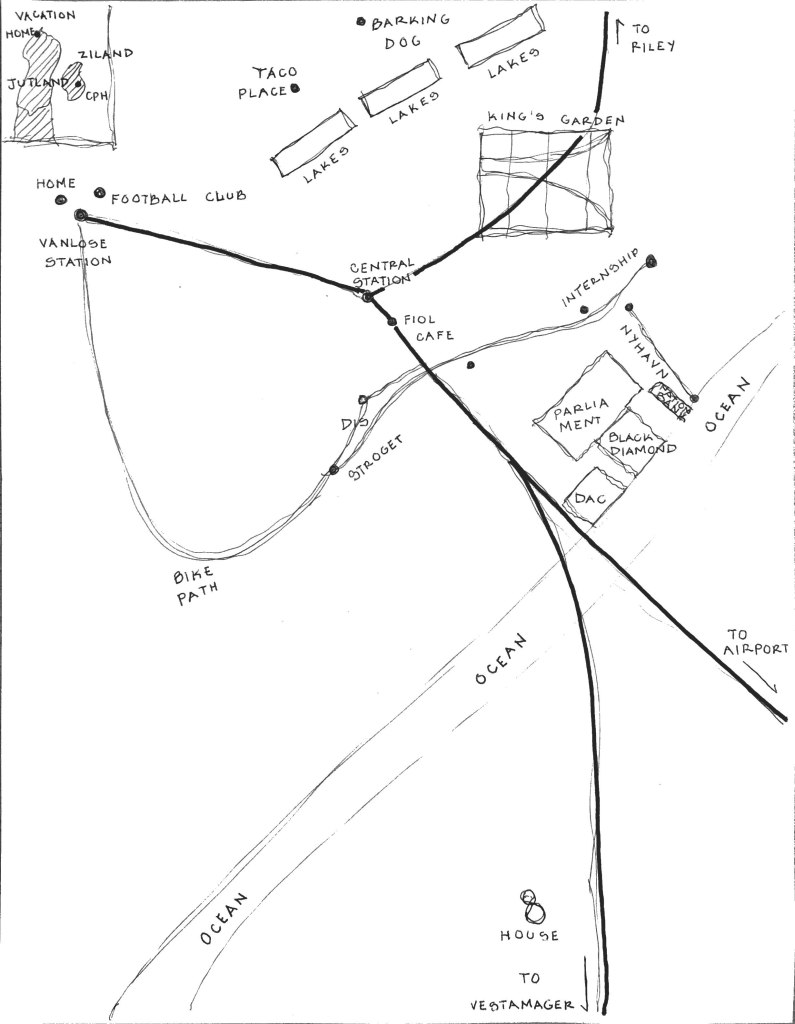
I think one of the most striking differences between my maps is the way I drew them. In the “before” drawing, I represent the two halves of Copenhagen as these two voids of streets and cityscape, with some architectural sites that I want to visit. In the “after” drawing, I throw out the rest of the city and focus only on the paths that I would follow to my different destinations in the city. I think this shows what I thought my goals were compared to what I actually wanted to do with my time once I was there. Before I departed to travel abroad, I thought that I would spend most of my time visiting different grandiose architectural sites. In reality, I spent much of my time discovering small coffee shops and study spaces where I could watch the world move around me.
Also, before I left, I had no idea where I would be living, or even if I would get a homestay. As a result, it isn’t on my “before” map, but it became a core part of my “after” map. Home became my launching off point at the beginning of the day, and my refuge at the end of long days exploring a foreign city. Like the government article said, “As you evolve as an individual abroad and adopt the culture practices of your foreign post, your perception of home changes.” I certainly fell into the routine of my host family, and the neighborhood around me. If anything, I’m realizing that I’m more attached to the small town of Vanløse and my home away from home, rather than the city of Copenhagen. I miss Vanløse, and the life I lived there.
By comparing the two maps, I’m reminded that there was still so much of Copenhagen that I wasn’t able to explore. One of the similarities between both maps is the fact that there is empty, unexplored space on both. I simply didn’t mark it with a hatch on my “after” map, perhaps as a way to communicate that I’m at peace with the fact that I wasn’t able to see every street of Copenhagen. By comparing the maps, it’s clear that what was important to me was the routine that I built up during my four months there, and the rest of the city fell the wayside as I became familiar, and dare I say comfortable, in my day to day routine. (Which is so weird to actually declare. I never expected to become comfortable in a foreign setting.)
Before I left for Copenhagen, I wrote myself a note, declaring that my goals for my abroad experience were to get to know this city and its people through the eyes of my host family, rather than as a tourist. I wanted to allow myself to step into their shoes rather than feeling anxious that I was missing something that the Americans were doing. I allowed my life to slow down, and intentionally carved out time to simply be at home with my host family, to enter their routine. And I’m proud to say that I think my mental map reflects this. The touristy sites were less important to me, and I spent about half my time exploring Vanløse. I also included a small map in the top left corner that shows the larger geography of the two islands, and where my host family’s vacation home was located, which we traveled to on multiple occasions.
The transportation I used completely affected my mental map. The metro system was impeccable. I used it every day to get to and from school, and after a few days, became completely familiar with the system. On my map, this is represented with the bold line running through the middle of the drawing. I did have a stretching experience when I lost my travel pass about a month before returning home, but ended up embracing the experience as a growth opportunity, and chose to ride my bike to and from DIS in extremely cold weather.
The transportation system was also some of my main sources of culture shock. Sure, there was the learning curve of navigating the system, but my time riding the metro was when I came into the closest contact with Danes who were on guard, and I experienced their public persona. I’ve written about this in earlier blog posts, but I was off put for a couple of weeks by how cold their public demeanor is. In America, people will smile or greet strangers in public. However, Danes are almost rude in the way they conduct themselves in public. A few weeks later, I would experience the warmth that Danes carry themselves with in private, and my eyes would be opened to the stark difference between their public and private persona. Nonetheless, it was still shocking.
Frankly, I loved this exercise to recreate my mental map. It honestly allowed me to revisit my time in Copenhagen after two and a half months of avoiding thinking about it. While it makes me sad to think about the fact that I won’t be in Copenhagen in that way ever again, I needed space to mourn that, which allows me now to be so grateful for the time that I did have. In the coming weeks, I want to look more closely at why my response to returning to America was to bury how much I missed Vanløse. Thanks for facilitating this Prof Gibson!
 Follow Me to DenMARK